Jenny and Pauline flee across America
American WomanJenny and Pauline flee across America after the news of a death turns their departure from the farmhouse into an immediate, irreversible break. Jenny drives them away from the people they have left behind, and the escape becomes a long journey marked by uncertain routes, a change of car, fear of recognition, and a return to California. Along the way, the flight exposes Pauline’s reasons for recruiting Jenny, tests the trust between them, and brings them back to a familiar community under an invented appearance.
The Break from the Farmhouse
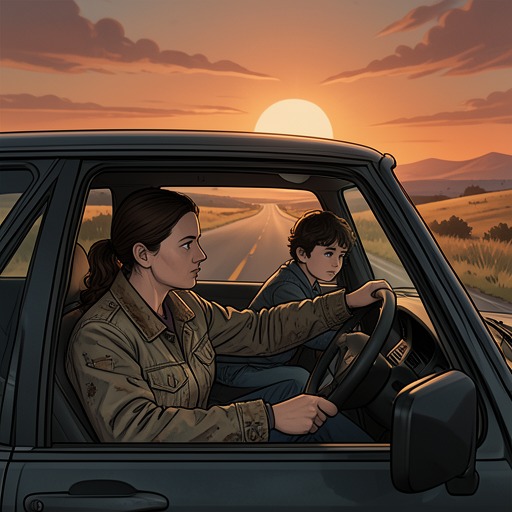
When Jenny tells Pauline to get into the car, Pauline is only just beginning to register the news Jenny has delivered. Jenny forces her into The Bug with a roughness that recalls Juan’s treatment of Yvonne, but is even less careful. Pauline recoils and falls onto the front seat. Her immediate protest is that they cannot leave the others; Jenny answers by repeating the command to leave. She stamps on the accelerator, turns the car in a half-circle, and drives down the hill without looking back. Juan might have heard the car or come out of the house, but Jenny does not check. Her departure is not a negotiated withdrawal from the group: it is a choice made in motion, with Pauline still objecting and the farmhouse already behind them.
The escape also brings Jenny’s accusation against Pauline into the open. Jenny says that Juan never threatened Pauline and did not make her recruit Jenny; Pauline recruited her to please the others. Pauline’s response confirms how much the cadre’s approval mattered to her: she had been pleased that they were pleased with her. The exchange revises the story Pauline had told Jenny about her recruitment and makes their relationship more complicated. Jenny can recognize the lie and still take Pauline with her; Pauline can admit her desire for approval while remaining dependent on the person who has exposed it.
That night, at a truck stop, Jenny calls Frazer from a pay phone for the last time. She tells him that they have finished their book. Frazer sounds surprised, apologizes for their fight, and says he will see her soon; Jenny echoes the farewell. The call links the flight to the completed manuscript and to the relationship Jenny is leaving behind. It is their last conversation, not a reunion: after it, Jenny and Pauline continue on their own.
Changing Cars and Crossing the Country
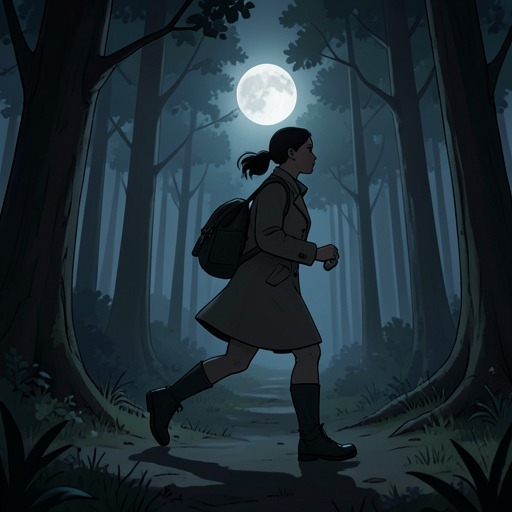
Late that night Jenny retraces the route to the farmhouse. She overshoots the driveway in the moonlight, doubles back, and finds the chain hanging between its posts. Rust powders her palms as she moves it aside. The small sign she had painted is gone, replaced by a mass-produced PRIVATE sign. The altered entrance is a concrete sign that the place has changed while she has been away. She drives past the dark house and the site of the former ice house toward the listing stables, intending to exchange The Bug for Dolly’s car if it is still there. Later, the women are traveling in Dolly’s car, which overheats on the road; the planned change of vehicle lets them continue the escape beyond the farmhouse.
In Indiana, the dense succession of towns and roads gives way to harvested cornfields. After sunset, Jenny and Pauline drive through country darkness for hours before finding a motel. At dawn, Jenny eases the door open and sees a few weatherworn buildings beneath a gray sky. There is one other car in the lot, still wet with night condensation. She slips out, puts the file and duffel back in the trunk, and starts the car. When it has warmed, Pauline comes out and gets in; together they drive away. The measured sequence—Jenny’s cautious preparation, Pauline’s quiet return to the car, then their departure—makes the journey look briefly like ordinary travel, though it depends on concealment and haste.
The road through Missouri offers no such calm. In a blinding rainstorm, the car dies after they pull onto the shoulder to consult their atlas. They turn on the hazard lights and wait in standing water while traffic fails to appear. When a huge truck finally passes, its wall of water strikes the car hard enough to make them fear for the vehicle’s ability to shelter them. Pauline’s cigarette is extinguished by rain through the cracked window. She tries to steady herself and Jenny, and Jenny repeatedly reassures her that they will be all right. The truck’s red taillights seem not to recede; then, through the downpour, a lone figure approaches with one arm raised. The flight’s danger is no longer just the possibility of being identified: for a moment, the car itself may not protect them from the road or weather.
Evasion, Trust, and the Turn West
After their encounter with the Missouri state troopers, Jenny and Pauline imagine that recognition may be dawning on the men who have seen them. Their thoughts extend the threat beyond the roadside: perhaps Dolly has recognized Pauline, perhaps the image has appeared on television, and perhaps a report or reward will follow. These are fears and possibilities the women imagine, not confirmed events. The uncertainty shapes the route. They drive west, then east as they picture the troopers catching up with the implications of what they have seen, then north after realizing they have gone too far east, and finally west again in a broad circle. Despite the elaborate imagined pursuit, nothing happens during that stretch; the danger occupies their thoughts more completely than it occupies the road.
Their car overheats somewhere west of the Mississippi, but Jenny knows how to manage it: they wait for it to cool. The delay gives the landscape time to enter the journey. They see sandhill cranes rising from a field and, on another day in a location they cannot place with certainty, pelicans circling above land far from the ocean. At the time, the birds seem magical to both women. Much later, Jenny will come across the fact that white pelicans migrate from the far North toward the Mexican coast through the Great Plains. She will not immediately understand why this knowledge makes her heart hurt. The retrospective detail gives the journey a second life in memory: what was then an improbable sight becomes part of a private landscape that remains with her.
As they travel farther west, they begin driving more often by day. Jenny’s money is gone, so they spend the stolen bills one at a time and at long intervals. Each expenditure lifts some of the burden they feel, and they take their time, zigzagging north and south rather than pressing toward a single destination. In a motel in Winnemucca, Pauline tells Jenny that, if caught, she would not betray her. She also recognizes that Jenny could have left her behind. Jenny assures her that she will not tell on Pauline, and Pauline says she knows this is the kind of person Jenny is. The exchange is a quiet counterweight to the earlier argument about deception: trust is not restored by erasing the lie, but established through what each woman says she will do now.
Return to California
The women discuss other possible places to settle, including Oregon and a small inland town, but their route carries them toward California. As they cross the valley, the flat green and yellow land—with sprinklers, rows of crops, and workers heading home—gives way to the deep folds of the coast range. When San Pablo Bay comes into view, they shout. Their response makes clear that the decision to return has, in practice, been made before they formally settle it. After the detours and anxious calculations, the familiar water draws them home.
Their return is first presented at Sandy’s home in North Berkeley. Sandy, recently back from a frightened period of self-exile with her sister in Tucson, opens the door to find Jenny on the porch. Jenny’s shoulder-length hair is tied in a small ponytail, and she wears a white blouse, a pleated blue skirt, and a Bible tucked under her arm. The churchgoing outfit makes her look like a local teenager, so Sandy takes a moment to recognize her. Jenny asks whether Sandy has heard the Good News. The disguise turns their arrival into a performance: Jenny approaches an old acquaintance as if she were a stranger with a religious message.
The Bible is part of that performance and another small episode of life on the road. Pauline had taken it from a motel room in Nebraska and produced it after they had driven away. Jenny pointed out that motels report stolen Bibles and joked that they were transporting one across state lines; seeing Pauline’s face, she made clear that she was teasing. The stolen object thus becomes a prop in Jenny’s return to North Berkeley, where she uses an appearance of conventional piety to conceal who she is. The journey ends not with a declaration that the fugitives are safe, but with their arrival at a familiar door, carrying the disguises and unsettled loyalties acquired along the way.